Skip to content

Desk organizers, ranked by capacity

The right organizer depends entirely on what actually clutters your desk — a few pens and cards need a very different solution than genuine paper filing. This guide runs by capacity, from the most complete to the smallest.

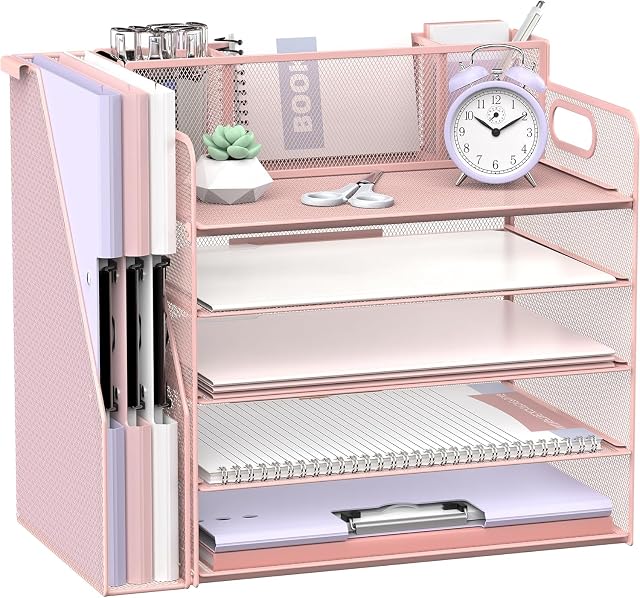
SUPTIDY is the most complete: five paper trays, three pen holders and a magazine holder, with a reconfigurable side file — the best fit for genuinely varied desk clutter.

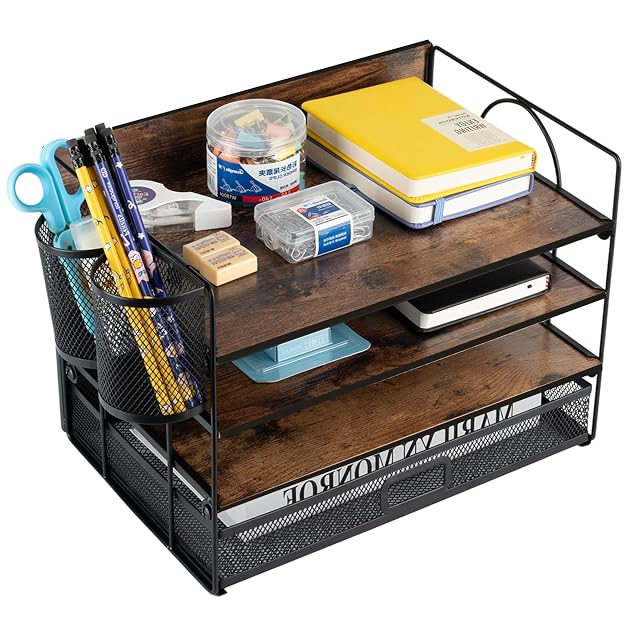
ZNMYDMT takes a four-tier vertical approach with wood trays on an iron frame — the only wood organizer here — saving desk footprint by building upward.

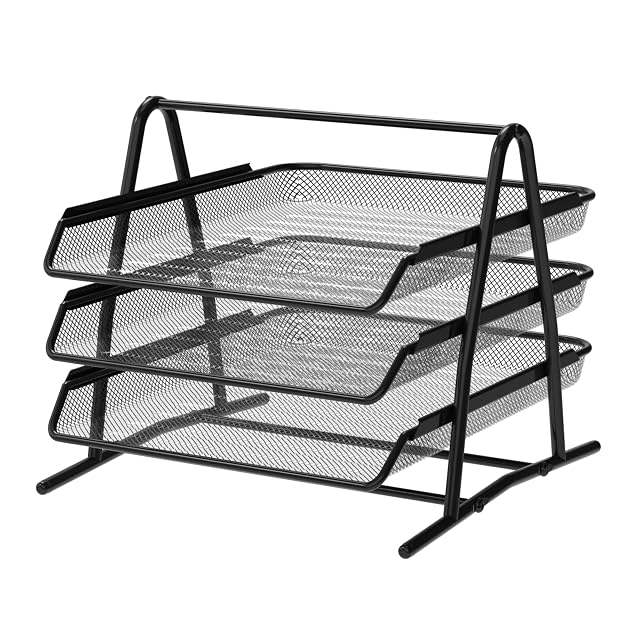
Detectalia focuses specifically on A4 document storage with three see-through wire mesh drawers, in a published 35.5 × 29.7 cm (14 × 11.7 in) footprint.

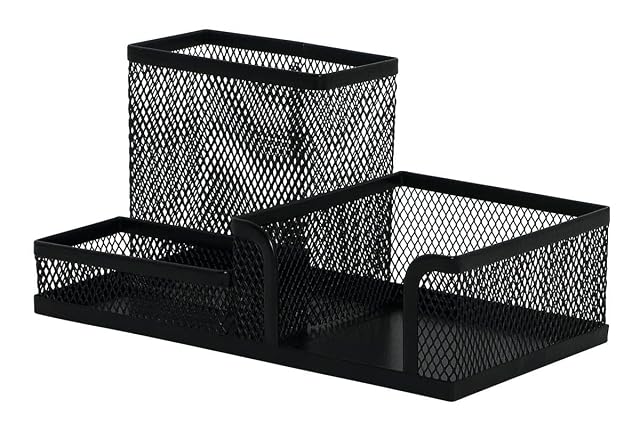
Q-Connect is the compact choice: three rotating compartments for pens and small items, ideal for a desk with limited surface area and no real paper-filing need.

Which one fits your setup?

Your desk is cluttered daily
The problem is usually where things live rather than the amount of storage, and an organizer only helps if it has a place for each thing.
You have a small desk
Tiered organizers that build upward — the SUPTIDY and the ZNMYDMT — use height instead of desk area; the Q-Connect takes 20.5 × 10.3 cm.
You work with paper
A tray system beats a pen pot, because paper is what actually covers a desk.
You mainly have cables
That is a cable management problem rather than an organizer problem, and the solutions are different.

Picking by how you work

Daily clutter

Pens, notebooks, the phone, the things you pick up constantly. An organizer works if each has a defined place.

Paper

Where trays and a filing habit matter, because paper accumulates faster than any organizer absorbs it.

Small desks

Where height is the space left: the tiered SUPTIDY and ZNMYDMT stack paper upward, and the compact Q-Connect holds pens in a small footprint.

Shared desks

Where an organizer is really about resetting the desk to a known state at the end of the day.

The points that matter after a month

Whether it fits what you actually own
Organizers are bought for an imagined tidy desk. Emptying your current desk onto a table first tells you what you need to store.
Footprint against gain
A large organizer that takes half a small desk has not helped. Tiered designs store upward; only the Detectalia (35.5 × 29.7 cm) and Q-Connect (20.5 × 10.3 cm) publish a footprint here.
Open or closed
Open storage is faster to use and shows the mess; closed storage looks tidier and hides what you stop using.
Paper handling
If paper is your problem, trays and a place for the current job matter more than compartments for small items.
Whether you will maintain it
An organizer is a habit with an object attached. A design that takes effort to use tends to be abandoned.

Which figure for which situation

Your clutterThe organizerThe real fix
Pens and small itemsA compartment trayFewer pens
PaperTrays and a filing habitDealing with paper daily
A small deskA tiered or compact organizerLess on the desk
CablesCable management, not an organizerRouting them once, properly

The usual missteps

Buying storage instead of reducing
An organizer makes clutter tidier rather than smaller. Emptying the desk and deciding what actually lives there is the step that works.
Choosing an organizer that occupies the space it saves
On a small desk this is easy to do. Tiered designs add storage upward without taking more working surface; check the size, which two of these four do not publish.
Closed storage for things you use hourly
Anything you reach for constantly belongs in open storage. Closed compartments are where things go to be forgotten.
Ignoring paper
Paper is what covers most desks, and pen pots do nothing about it. A tray and a daily habit do far more.

By the person using it

The paper worker
Trays, a single in-place for current work, and a daily habit of clearing them.
The small-desk user
A tiered organizer that builds upward, or a compact pen tray, measured against the free corner of the desk.
The minimalist
One small tray and a decision about what actually needs to be on the desk at all.

Wear, warranty and working life

Organizers do not break; they stop being used. What actually degrades is the habit, and an organizer full of things nobody has touched for six months is doing the opposite of its job.

  • Empty and reassess it periodically; contents accumulate silently.
  • Wipe out compartments, which collect dust and pen marks.
  • Move anything untouched for months out of the desk entirely.
  • Keep the surface it stands on clean, since it rarely gets moved.

Safety

Very low risk, with a couple of practical points.

  • Keep scissors and blades in a closed compartment, especially in a household with children.
  • Do not stack heavy organizers where they can fall from a shelf.
  • Keep drinks away from the paper tray, which is a familiar disaster.
  • Route cables away from anything that gets moved daily.

The picks, and the grounds for them

What buyers ask us first

How do I pick between these without overbuying?

List what actually clutters your desk — pens, paper, magazines — before choosing. A small organizer for a paper-heavy desk won't help; a large multi-tier system on a minimal desk is wasted space.

Which organizer holds actual documents, not just pens?

Three of them: the SUPTIDY’s five trays and side file, the ZNMYDMT’s four letter and A4 trays, and the Detectalia’s three A4 drawers. The Q-Connect’s three compartments are for pens, clips and cards only.

Will an organizer tidy my desk?

It makes clutter tidier rather than smaller. Deciding what actually lives on the desk is the step that changes things, and the organizer supports it.

What size should I buy?

Whatever fits what you actually own. Emptying the desk onto a table first tells you more than any product description.

Open or closed compartments?

Open for anything you reach for constantly; closed for things you use rarely and want out of sight. Closed storage is where things get forgotten.

How do I deal with paper?

Trays and a daily habit of clearing them. Paper is what covers most desks, and small-item organizers do nothing about it.

What about cables?

That is a separate problem with separate solutions: trays under the desk, clips along the edge, and routing them once properly.

My organizer has become clutter itself. What now?

That is normal and it means the contents have accumulated. Empty it, remove anything untouched for months, and keep only what earns its place.

Each pick, and the setup it suits

SUPTIDY Multi-Tier Organizer

Intended for: A desk with varied clutter — papers, pens and magazines — and room for a multi-tier unit.
Its best feature: The most paper storage in this hub: five trays, plus a side file and a magazine holder

Its worst feature: No size published, on the organizer with the most parts

Read the full review →

ZNMYDMT Wood & Metal Organizer · $25

Intended for: A smaller desk that needs paper storage built upward, with a warmer look than bare wire mesh.

Its best feature: The only organizer in this hub with wood trays, on an arched iron mesh frame

Its worst feature: No size published — check the height under a shelf or cabinet

Read the full review →

Detectalia Mesh Organizer · $60

Intended for: A paper-heavy desk with room for a 35.5 × 29.7 cm (14 × 11.7 in) footprint.

Its best feature: The only organizer in this hub with sliding drawers you can count: three, sized for A4 documents

Its worst feature: The widest published footprint in this hub, 35.5 cm (14 in)

Read the full review →

Q-Connect KF16572

Intended for: A small desk that needs pens, clips and a few cards kept within reach.

Its best feature: Rotates to bring each of its three compartments within reach

Its worst feature: Three compartments and no paper storage

Read the full review →

What you will want with it

Accessories and spares that go with these picks, at the price we noted. Check each one fits what you own before ordering — the listing states the sizes and part numbers.

  • Eglooh Mercurio · Desk pads — Made in Italy · regenerated leather · non-slip scratch-resistant base
  • Gokemuak XXL Shortcut Pad · Desk pads — 90×40cm (35.4 × 15.7 in) · 3mm thick · printed shortcuts
  • 3M DH340MB · Document holders — 150 sheets · portrait or landscape · line guide · $23
  • Abankey KLOUD City · Document holders — 13.9 × 8.2 in · 7 grooves · removable line guide · $14
  • AIWE7D MiniLJT03 · Desk trash bins — 0.5 gal · 6.5 × 6.5 × 6.7 in · press-top · bags included · $20
  • Amazon Basics 2818BK-A2 · Desk trash bins — 7 gal each · 14.4 × 10.3 × 15 in · pair · co-polymer PP · $14

The quick version

Pairings that decide it

Head to head, already written, within this guide or this aisle.

How this list was assembled

The products here come from the catalog of this site. Specifications are those the maker and the Amazon listing publish; prices are the Keepa reading for the date below, and both shift. Ranking follows declared specifications, stated strengths set against stated limits, and price. Nothing here has been tested hands-on by us, and no page pretends it has.

Last checked on

Prices quoted in these summaries are dated readings. The live price is shown next to each product.

The tool we use ourselves

Chosen your tool? Now buy it at the right price.

Office chairs and standing desks swing by thirty dollars or more across the year, and the biggest "discounts" often land at prices the same model sold for six weeks earlier. UniverTrack tracks the real price history across retailers, spots fake reductions, and alerts you when it is genuinely the moment to buy.

Real price historyBuy-now alertsAI buying assistant
Try free for 14 days →
No commitment · Cancel in one click · 5 languages