Skip to content

The best desk wireless chargers for 2026

A charger's advertised wattage is a ceiling, not a guarantee — the phone on top of it negotiates the actual charging speed, and a phone capped at a lower wattage will not charge any faster on a higher-wattage pad. We compare stated maximum output against common phone charging standards, genuine Qi certification (relevant for both charging speed and phone safety circuitry), tolerance for charging through a phone case, and stand against flat pad orientation for keeping a screen visible while charging.

What we recommend

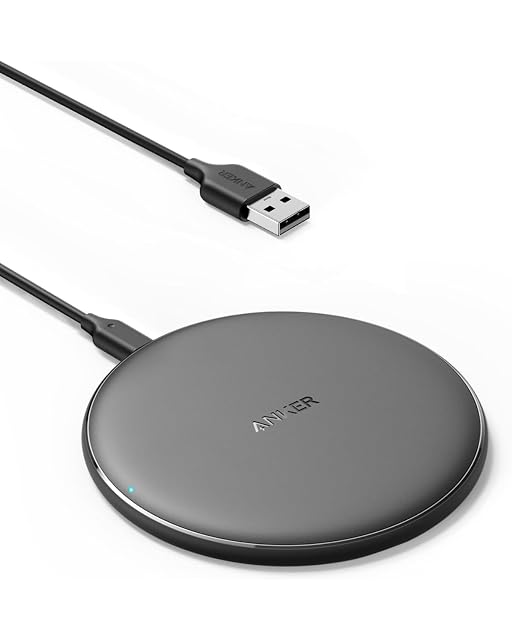
  1. Anker PowerWave wireless charging pad on a desk

    Anker flat wireless charging pad

    A budget flat wireless charging pad from Anker, delivering up to 10W for Samsung Galaxy phones and 7.5W for iPhones, with an LED charge indicator.

    Amazon reference
    B07THHQMHM (identical on 6 markets)
    EAN
    0848061060119
    • Up to 10W charging for supported Samsung Galaxy phones, 7.5W for iPhones
    • LED indicator shows charging status at a glance
    • A Micro-USB cable is included rather than USB-C, worth checking against your existing charger/cable setup

    Best for: A dependable, budget wireless charger from an established brand, for phones that support 7.5–10W charging.
    Check price on Amazon
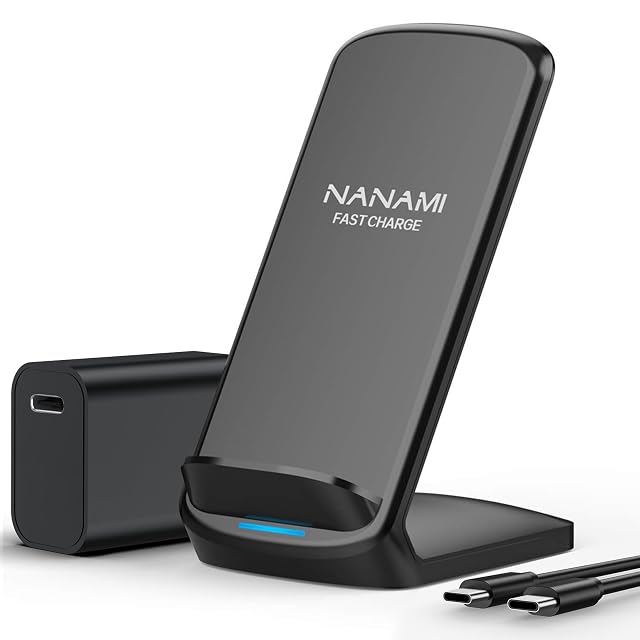
  2. NANAMI wireless charging stand holding a phone upright

    NANAMI stand-style wireless charger with dual coils

    A stand-style wireless charger with two coils supporting both vertical and horizontal phone orientation, dimmed sleep-friendly lighting, and multiple safety protections.

    Amazon reference
    B07H6C7H7D (identical on 5 markets)
    EAN
    0772629757299
    • Stand format lets the phone charge while remaining visible for notifications
    • Two built-in coils give a genuinely wider charging area and support both vertical and horizontal orientation
    • Higher price than the flat pad elsewhere in this hub

    Best for: A bedside table or desk where seeing notifications while charging matters, and a flat pad is less convenient.

    Check price on Amazon

Who each type suits

Topping up during the day
Setting the phone down between uses keeps the charge up without thinking about it. The use best suited to the format.
A tidy desk
A pad removes one cable from the work surface. At a workstation where the cables are already managed, the gain is visible.
Fast charging
Wired charging stays faster and cooler. For a full charge before leaving, the cable wins.

The trade-offs to weigh

Comfort against speed and heat
Wireless charging is slower and dissipates more heat than a cable. Heat is what ages a battery.
Angled stand against flat pad
An angled stand lets you see the screen and calls for precise placement; a flat pad accepts the phone in any position.
Stated power against real power
The advertised power assumes a compatible device, an adequate power supply and good alignment. All three are often missing.

Questions buyers ask

Does wireless charging damage the battery?

It produces more heat than wired charging, and heat is what ages a battery. The effect is real and moderate at these powers.

Why is it charging slowly?

Imperfect alignment, too thick a case, or an inadequate power supply. All three are frequent and cumulative.

Should I take the case off?

A thin case generally passes; a thick or metal one blocks the charge. So do metal plates for magnetic mounts.

Does the charger work with every phone?

With those that support induction charging on the common standard. The maximum power, on the other hand, depends on the model.

Is the power supply included?

Often not, and that is what limits the real power. An undersized brick brings the charge back to its slowest speed.

Can I charge on it overnight?

The devices manage the end of charge. The heat given off over a night stays higher than with a cable.

Is a bank card set on it at risk?

Contactless chip cards must not sit between the charger and the phone. The field can damage them.

What to remember

Wireless charging buys the comfort of setting down, not speed: it is slower and warmer than a cable. Whether the power supply is included or not decides the real power, and no contactless card should sit between the pad and the phone.