Ergonomic office chairs, ranked by what they adjust
A chair's price mostly buys adjustment range, not comfort in the abstract — a fixed lumbar curve against an 8-step adjustable pad, fixed armrests against ones that fold and slide. This order puts the most heavily documented and certified chair first and the simplest last.
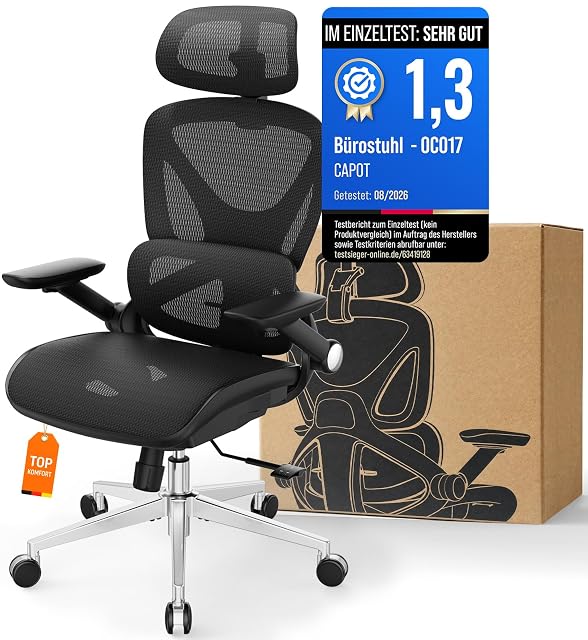
Two of these four chairs name an independent test: CAPOT states BIFMA X5.1 certification, and Yaheetech cites an SGS report on its gas spring and BIFMA requirements for its main components. Marsail names none, and ELITESEATS says only that its chair was tested, without naming the test. Beyond that, the decision comes down to what adjusts and by how much — and to seat height, where the only two listings that give a range do not even overlap: 35–45 cm (13.8–17.7 in) on the Yaheetech, 47–56 cm (18.5–22 in) on the CAPOT.
CAPOT tops this list for its 8-step, 5cm lumbar adjustment targeting the L1–L5 region specifically, BIFMA X5.1 certification, and a 5-year parts warranty — the most documented chair we reviewed in this hub, recommended for users 165–188cm.
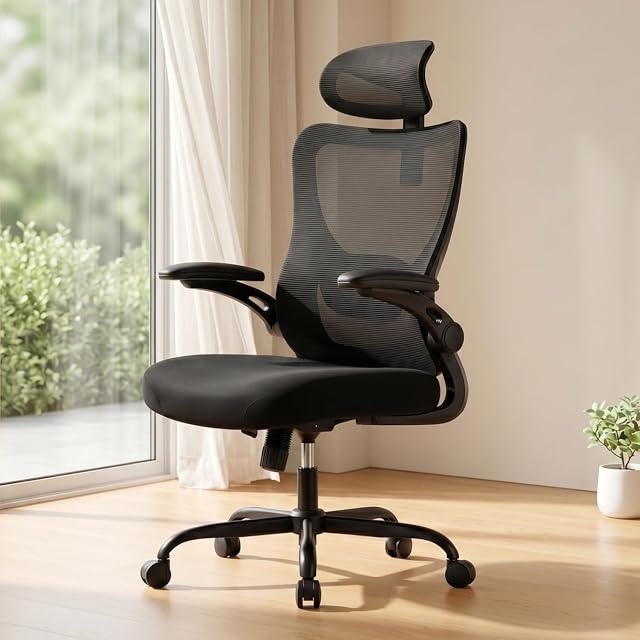
Marsail is the pick for anyone who wants a genuinely adjustable lumbar pad (not just a fixed curve) and folding 3D armrests, and it is the only chair here that gives a figure for every adjustment it names — 3 cm and 5.5 cm of lumbar travel, a 45° headrest tilt, a 150 kg (330 lb) capacity. It is also the only one of the four listed on Amazon.com, though no US price was read for it.
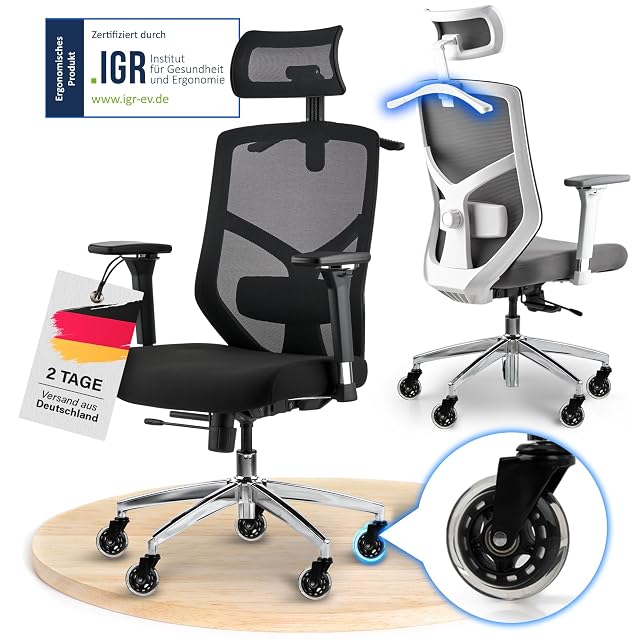
ELITESEATS brings purpose-built armrests and hard-floor-specific silent casters, though its listing gives no range for its seat height, lumbar support or headrest, and states its 150 kg (330 lb) capacity only in the title.
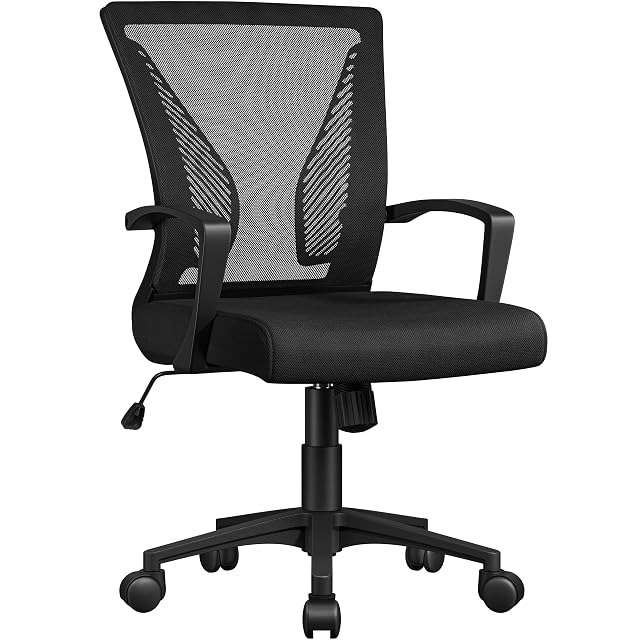
Yaheetech is the simplest chair here: a low 35–45 cm (13.8–17.7 in) seat range and an SGS-tested gas spring, at the cost of a fixed lumbar curve, fixed armrests, no headrest and no published weight capacity.
Which one fits your setup?
You sit for most of the working day
The chair is the single item worth spending on, because it is the one you are in contact with for hours.
You are tall or short of average
Seat depth and back height matter more than any feature list, and most chairs are built around an average frame.
You already have back pain
That is a matter for a healthcare professional first; a chair supports a change of habit rather than replacing advice.
You share the chair
Adjustability without tools becomes the criterion, because a chair nobody adjusts fits nobody.
Picking by how you work
Full-time desk work
Where adjustment range, seat comfort over hours and back support all matter, and where a poor chair is felt daily.
Occasional home use
A few hours a week asks much less of a chair, and a modest one is entirely reasonable.
Shared or hot-desking
Fast, tool-free adjustment, because the chair changes user rather than the user changing chair.
Standing desk alternation
Where the chair matters less because you are not in it continuously, though it still needs to fit.
The points that matter after a month
Seat height and depth
Feet flat on the floor and a gap between the seat edge and the back of your knees. Seat depth adjustment is what makes a chair fit different leg lengths.
Lumbar support that adjusts
Fixed lumbar support fits whoever the designer had in mind. Height-adjustable support is what lets it meet the curve of your own back.
Armrest adjustment
Armrests should let your shoulders drop and your forearms rest without lifting. Fixed armrests that are too high are worse than none.
The recline mechanism
Whether it locks, whether the tension can be set to your weight, and whether you can actually move. A chair that holds you rigid is not the goal.
Build and what can be replaced
Gas lift, casters and mesh are the parts that fail. A chair with replaceable parts has a much longer useful life.
Which figure for which situation
Your situation
What to prioritize
What matters less
Full-time desk work
Adjustment range and seat comfort
Appearance
A few hours a week
A comfortable seat
Extensive adjustment
Shared chair
Tool-free adjustment
A perfect single fit
Tall or short
Seat depth and back height
Feature count
The usual missteps
Buying a chair and never adjusting it
An expensive chair set wrongly is worse than a modest one set well. Setting seat height, depth and armrests takes ten minutes and changes everything.
Choosing on appearance
Gaming and executive styling says nothing about how a chair supports you over eight hours. The shape that looks supportive often is not.
Expecting a chair to fix pain
A chair can support better habits. Persistent pain is a matter for a healthcare professional, and no purchase substitutes for that.
Ignoring the gas lift
It is a part that wears and one that can often be replaced if the chair allows it. The CAPOT includes replacement parts in its five-year warranty; the Yaheetech cites an SGS test on its gas spring.
By the person using it
The full-time desk worker
Full adjustment, a seat that stays comfortable for hours, and replaceable parts.
The occasional user
A comfortable, sturdy chair. Extensive adjustment goes unused when the chair is used for an hour at a time.
The shared workspace
Tool-free adjustment and a clear range, so each person can set it in seconds.
Wear, warranty and working life
Office chairs wear at their casters, their gas lift and their upholstery. Casters clog with hair and grit and then mark floors, and a gas lift that sinks slowly is a known, often replaceable fault rather than a sign the chair is finished.
Clean hair and grit from the casters; they are what damage floors.
Check whether the gas lift can be replaced before assuming a sinking chair is scrap.
Tighten the fixings periodically; every chair loosens with use.
Vacuum fabric and wipe mesh rather than soaking either.
Safety
A chair carries your whole weight on a gas cylinder and five casters.
Do not stand on an office chair; the casters and the swivel make it unstable.
Check the weight rating and stay within it.
Retighten the base and seat fixings periodically.
Take breaks and change position regularly; no chair replaces movement, and persistent discomfort deserves professional advice.
3D armrests · adjustable lumbar · 150 kg (330.7 lb) capacity
A mesh chair with a separate adjustable lumbar pad, 3D armrests that fold up 90°, an adjustable headrest and a stated 150 kg (330.7 lb) capacity, at about €80 on amazon.de.
Best for: Someone who wants an adjustable lumbar pad and folding armrests for well under half the price of the CAPOT.
35–45 cm (13.8 to 17.7 in) seat height · mesh back · 90–120° tilt
A low-priced mesh chair with a curved backrest, a 35–45 cm seat and a rocking tilt, with an SGS test report for its gas spring and components stated to meet BIFMA requirements.
Best for: A first ergonomic upgrade from a flat dining chair, on a tight budget.
No — the simplest chair here, the Yaheetech, still adjusts its seat height (35–45 cm, 13.8 to 17.7 in) and its backrest angle (90–120°). What the better-equipped chairs add is an independently adjustable lumbar support, adjustable armrests and a headrest, not a fundamentally different sitting position. Check the seat height range first: the Yaheetech tops out at 45 cm, below the 47 cm where the CAPOT starts.
What matters more than price when choosing?
Count the number of things that actually adjust — lumbar depth, armrest height and width, seat height, tilt — rather than judging by padding thickness in a photo.
How much should I spend on an office chair?
In proportion to how long you sit in it. For full-time desk work it is the one purchase that is felt every day; for a few hours a week a modest chair is fine.
What should I adjust first?
Seat height so your feet are flat, then seat depth, then lumbar support and armrests so your shoulders drop. Each takes a minute, and a chair left on its factory settings fits whoever it was set for.
Is mesh better than foam?
Mesh breathes and suits warm rooms; foam is softer and often more comfortable for long sittings. It is preference rather than a hierarchy.
Will a better chair fix my back pain?
A chair can support better habits, but persistent pain is a matter for a healthcare professional. No chair is a treatment.
Why does my chair sink?
The gas lift is usually failing — a known and often replaceable part rather than the end of the chair. When a chair sinks shows how to measure for a new one.
Are gaming chairs good office chairs?
Some are, many are not. The bucket shape and fixed features suit a specific posture, and appearance says nothing about eight-hour support.
Intended for: Someone who wants an adjustable lumbar pad and folding armrests for well under half the price of the CAPOT.
Its best feature: Lumbar pad adjusts 3 cm (1.2 in) forward/back and 5.5 cm (2.2 in) up/down, independent of the backrest shape
Its worst feature: The seat height travel is given (10 cm, 3.9 in) but not its lowest and highest positions, so the fit against a given desk cannot be checked from the listing
Intended for: A buyer in Europe on a hard floor who wants three set recline positions and 4D armrests, and can check the fit in person or on return.
Its best feature: Backrest locks at three fixed angles — 90°, 110° and 135° — rather than a single position
Its worst feature: The listing names an adjustable lumbar support, headrest, seat height and 4D armrests but gives no range for any of them; the 150 kg (330 lb) capacity appears only in the listing title
Accessories and spares that go with these picks, at the price we noted. Check each one fits what you own before ordering — the listing states the sizes and part numbers.
Frassie KD-J13-350 · Chair casters — 28 in · 5 casters + 5 bell glides · 2 in hole · 11 × 22 mm (0.43 × 0.87 in) · $50
The products here come from the catalog of this site. Specifications are those the maker and the Amazon listing publish; prices are the Keepa reading for the date below, and both shift. Ranking follows declared specifications, stated strengths set against stated limits, and price. Nothing here has been tested hands-on by us, and no page pretends it has.
Last checked on
Prices quoted in these summaries are dated readings. The live price is shown next to each product.
The tool we use ourselves
Chosen your tool? Now buy it at the right price.
Office chairs and standing desks swing by thirty dollars or more across the year, and
the biggest "discounts" often land at prices the same model sold for six weeks earlier.
UniverTrack tracks the real price history across retailers, spots fake
reductions, and alerts you when it is genuinely the moment to buy.
Real price historyBuy-now alertsAI buying assistant