Skip to content

Mushyn two-zone chair mat with a cushioned footrest

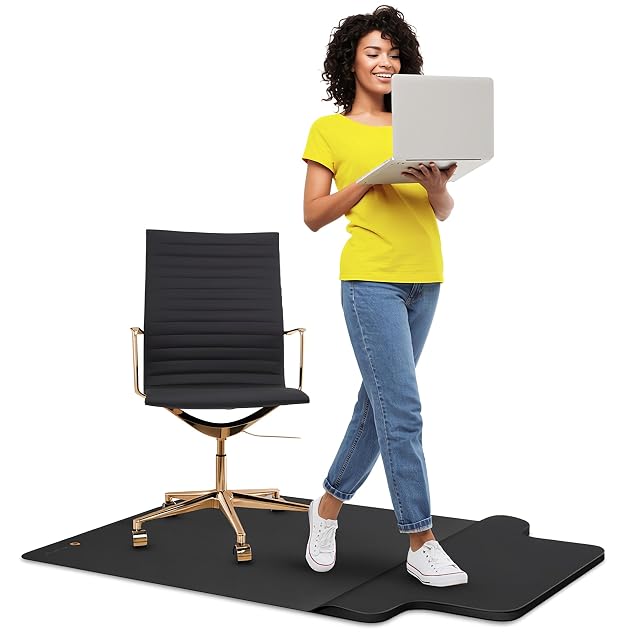
A single 54 by 36 in mat split into a thin zone for chair casters and a cushioned zone for standing, with the maker stating which part the wheels must stay off.

Mushyn two-zone office mat with a smooth rolling area and a cushioned footrest section

Mushyn two-zone chair mat with a cushioned footrest

  • One mat covers both postures — a rolling zone for the chair and a cushioned zone for standing
  • 54 by 36 in, with a stated minimum depth of 22 in for placement — the largest here after the 92 × 152 cm YBAYMY
  • The bullets give no thickness for either zone; the product page measurements give 0.8 in overall without saying which zone it describes

Best for: A sit-stand desk on a hardwood floor, where two separate mats would be in each other’s way.

≈ $70
Check price on Amazon
Specifications

Amazon reference
B0D3HZ2VLD
EAN
5949096162276
Thickness
20 mm, 0.8 in (overall)
Length
137 cm, 54 in
Size
54 × 36 in (137 × 91 cm), two zones
Material
PVC over NBR foam
Surface
Rolling zone and cushioned footrest
Bevelled edge
Low-profile edges

Everything else in this hub is a mat you stand on. This is a mat you do both on: a single 54 by 36 in sheet with a thin, smooth zone for the chair casters and a cushioned anti-fatigue zone at the front for standing — which is the awkward geometry of a sit-stand desk solved in one piece instead of two overlapping ones.

The listing is better than most at saying how it must be used. The chair rolls only on the thin zone; the cushioned part is pulled forward when the desk goes up; the mat needs a minimum of 22 in of depth to sit properly; and the intended user stands for roughly 20 to 40 per cent of the working day. Materials are PVC over an NBR foam core, stated CA Prop 65 compliant, phthalate-free and heavy-metal-free, and safe for hardwood, tile, laminate, vinyl and concrete.

What the bullets do not give is a thickness for either zone — “thin rolling zone” and “cushioned footrest” are the whole of it. The product page measurements add 54 × 36 × 0.8 in and a maximum capacity of 250, but not which zone the 0.8 in (20 mm) describes or the unit of the capacity; on a shelf where the published thicknesses run from 12 mm to 25 mm, the cushioning is only half quantified. The cushioned area also does double duty as a footrest while seated — a reasonable use of the same foam, and a different load from a standing heel.

Availability

Read on the day this page was built: $70 at the American Amazon shop.

Read from Keepa on the day this page was last revised; stock and price both move without notice.

What holds up, and what does not

Best for: A sit-stand desk on a hardwood floor, where two separate mats would be in each other’s way.

Strengths

  • One mat covers both postures — a rolling zone for the chair and a cushioned zone for standing
  • 54 by 36 in, with a stated minimum depth of 22 in for placement — the largest here after the 92 × 152 cm YBAYMY
  • States which zone the casters must not cross, rather than leaving it to be discovered
  • PVC over an NBR foam core, stated CA Prop 65 compliant, phthalate-free and heavy-metal-free
  • Stated safe for hardwood, tile, laminate, vinyl and concrete

Compromises

  • The bullets give no thickness for either zone; the product page measurements give 0.8 in overall without saying which zone it describes
  • The cushioned area is a footrest for a seated user as well as a standing surface, which are different jobs
  • Only suits a particular pattern of use — the listing names 20 to 40 per cent standing time
  • A 54 by 36 in mat is not something that gets moved aside

Prices quoted in this text were read on 2026-10-12. The live price is at the top of the page.

What buyers ask us first

Can the chair roll on the cushioned part?

No, and Mushyn says so rather than leaving it as a discovery: "when seated, keep chair wheels on the thin rolling zone; when standing, place the cushioned footrest in front of the desk. Chair wheels should not roll over the anti-fatigue cushioned area." A caster on a soft foam zone sinks in and either stops or tears it, which is the reason two-zone mats exist at all.

Who is it actually for?

The listing gives a figure, which is unusual: it is "Ideal for users who primarily sit and take regular standing breaks throughout the day (about 20–40% of work time)". Above that proportion you are standing on a mat sized as a footrest; below it you are paying for a cushioned zone you rarely use. It is the only listing in this hub that defines its buyer by behavior rather than by floor type.

All anti-fatigue mats