The part under the seat, sized by its bolt pattern
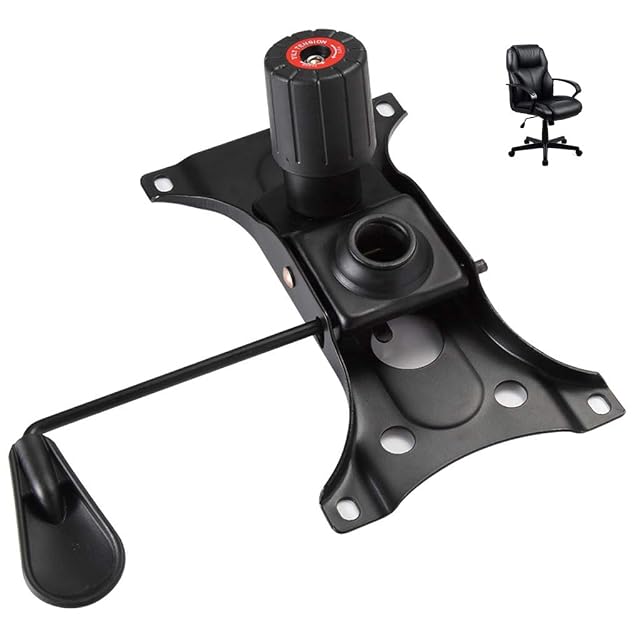
Skelang seat tilt and swivel control mechanism
The plate that bolts under a chair seat and carries the tilt, swivel and height controls, published with the two dimensions that decide whether it fits — the cylinder hole and the bolt pattern.
Skelang seat tilt and swivel control mechanism
Publishes the bolt pattern, 10.2 by 6 in, which is the measurement that decides fit on a mechanism
Publishes the gas cylinder hole diameter, 1.57 in, separately from the bolt pattern
The bullets give the bolt pattern twice and disagree — "10.2"×6"" in the title, "6" - 10" bolt pattern" in the size bullet
Best for: A chair whose seat and base are sound but whose height lever or tilt has stopped working.
10.2 × 6 in (26 × 15 cm) in the title; "6 - 10 in" in a bullet
Cylinder hole
1.57 in (40 mm)
Material
Steel bracket, 0.1 in (2.5 mm)
Stated load
Not published
Tilt range
Not published
When a chair stops holding its height or will not lock its tilt, the fault is in a steel plate the size of a hand bolted under the seat — and this is that plate. It carries the gas cylinder socket and the levers, and it can fail while the seat, the base and the casters are all still good.
Fit is decided by two measurements and the listing publishes both: a gas cylinder hole of 1.57 in and a mounting hole pattern given as 10.2 by 6 in. The bracket is stated at 0.1 in of steel. That is the right information — the same standard the Frassie and MASTERY MART bases meet by publishing their cylinder hole and caster sockets.
The one problem is that the two bolt-pattern statements on the page do not match. The product name says 10.2 by 6 in; the size bullet says “6” - 10” bolt pattern” and then refers you to the third photograph. Those are the same numbers arranged as a rectangle in one place and as a range in the other. And nowhere does the listing publish a load rating, on the single part of a chair that carries the whole of the sitter — while two bases a few rows down this shelf claim 2,500 lb each.
Availability
Read on the day this page was built: $22 at the American Amazon shop.
Read from Keepa on the day this page was last revised; stock and price both move without notice.
What holds up, and what does not
Best for: A chair whose seat and base are sound but whose height lever or tilt has stopped working.
Strengths
Publishes the bolt pattern, 10.2 by 6 in, which is the measurement that decides fit on a mechanism
Publishes the gas cylinder hole diameter, 1.57 in, separately from the bolt pattern
Steel bracket stated at 0.1 in thick
Replaces the part that actually fails on an otherwise sound chair — the lever and tilt assembly
A few minutes to fit, per the listing
Compromises
The bullets give the bolt pattern twice and disagree — "10.2"×6"" in the title, "6" - 10" bolt pattern" in the size bullet
No load rating published at all, on the part that carries the sitter
No tilt range or tension adjustment described
Refers you to a product photograph for the sizes rather than printing them all
Prices quoted in this text were read on 2026-10-13. The live price is at the top of the page.
What buyers ask us first
Which bolt pattern does it have?
The listing gives it twice in two forms. The product name ends "Mounting Hole Dimension: 10.2"×6"(L×W)", and the size bullet says "the tilt control mechanism is 6" - 10" bolt pattern (Check the third image for size information before order)". Read together, the holes are 10.2 in apart one way and 6 in the other — but the bullet’s phrasing reads like a range, and the listing itself sends you to an image rather than settling it. Measure your own plate in both directions before ordering.
How is this different from replacing the base?
They are the two halves of the same repair and they fail for different reasons. The mechanism is the plate bolted under the seat that holds the gas cylinder and carries the tilt and height levers; the base is the five-star spider the casters go into. A chair that will not hold its height has a cylinder or mechanism fault; a chair that wobbles or has a cracked arm has a base fault. This shelf now carries both, and the figure that matters is different for each — bolt pattern here, base diameter and cylinder hole there.
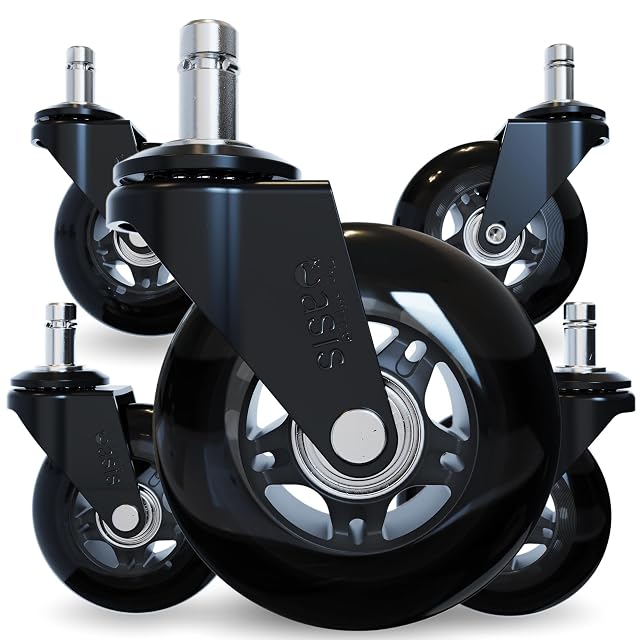
Rollerblade-style casters sold on a lifetime warranty and an origin story rather than a specification — there is no load rating, stem size or wheel diameter on the listing.
Amazon reference
B0CGJY6KJP
EAN
0850009847058
Manufacturer reference
OAS-1020
In the box
5 casters
Stem
"Universal"; dimensions not published; separate IKEA-only version
Wheel
Rollerblade style, polyurethane encased; diameter not published
Floors
Hardwood, carpet, tile, laminate
Stated load
Not published
Warranty
Lifetime, replacement set
A stated lifetime warranty — the longest commitment in this hub, with replacement sets promised
Polyurethane-encased wheels, guaranteed by the maker not to scratch or mark any floor
No load rating, no stem dimension and no wheel diameter published anywhere on the listing
Best for: A buyer who would rather have a warranty they can call on than a number they cannot check.
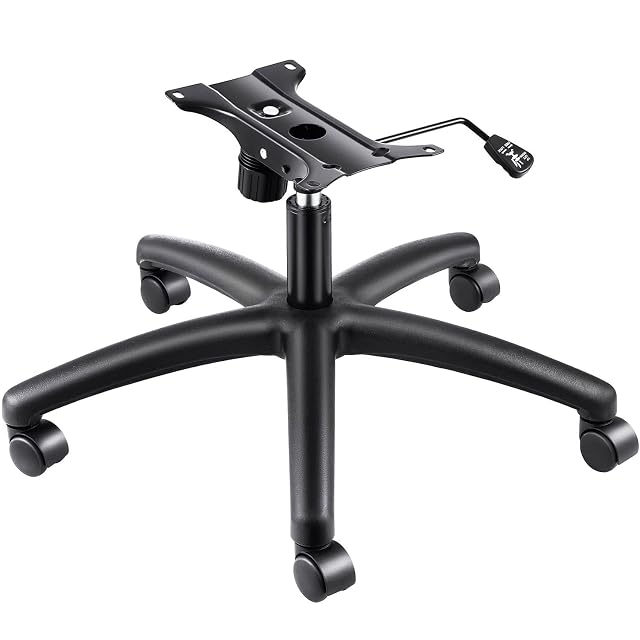
A four-part kit — base, gas cylinder, bottom plate and five casters — that publishes a 350 lb capacity and 110 lb per caster: the lowest figures on this shelf, though five casters at 110 lb make 550, not 350.
Amazon reference
B0B6MZYX5M
EAN
0723496924710
In the box
Base, gas cylinder, seat bottom plate, 5 casters
Base diameter
28 in (71 cm)
Cylinder travel
5 in (12.7 cm); seat range 14.5–19.5 in (37–50 cm)
Plate bolt pattern
10.2 × 6 in (26 × 15 cm)
Casters
5 × 60 mm (2.36 in); stem size not published
Stated load
350 lb (159 kg) total; 110 lb (50 kg) per caster
Weight
22.5 lb (10.2 kg)
Warranty
1 year
A complete kit — base, gas cylinder, bottom plate and five casters — rather than one part
Publishes a load per caster, 110 lb, as well as a total, 350 lb — the lowest figures on this shelf
The highest price in this hub, though it is four parts rather than one
Best for: A chair where more than one thing has failed, and the seat is the only part worth keeping.
A 36 in two-tier converter on a steel spring lift with thickened square tubing, rated 33 lb and 4.4 lb — and the only converter here with no height range on its listing.
Amazon reference
B0GZMQHC5S
EAN
0840521569088
Manufacturer reference
M57
Width
36 in (91 cm)
Height range
Not published
Depth
Not published, for either tier
Load
33 lb (15 kg) top; 4.4 lb (2 kg) keyboard tray
Lift
Mechanical steel-wire spring, patent pending
Frame
Reinforced steel, thickened square tubes
Assembly
Almost fully assembled; fit the keyboard tray
Finish
Walnut
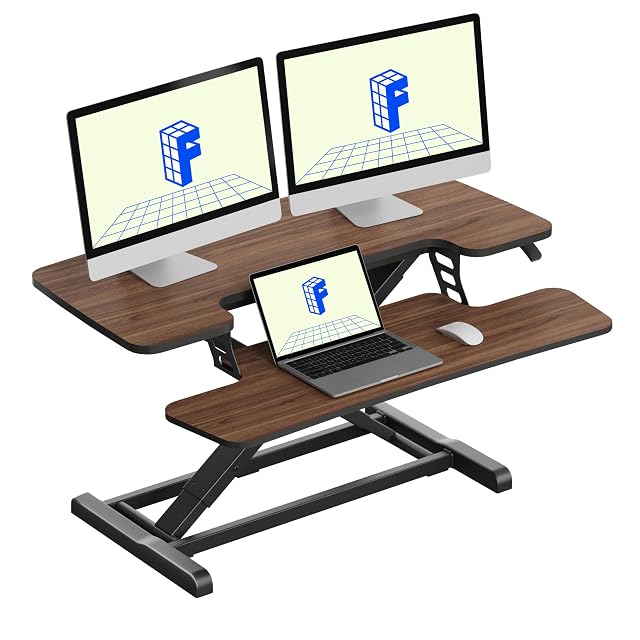
A 36 in surface, which FLEXISPOT sizes for two monitors with room beside them
Mechanical steel-wire spring rather than a gas cylinder, with no pressure to lose
No height range published anywhere on the listing, where every other converter here states both ends of its travel
Best for: A dual-monitor desk where a spring lift is wanted and the height can be checked on delivery.
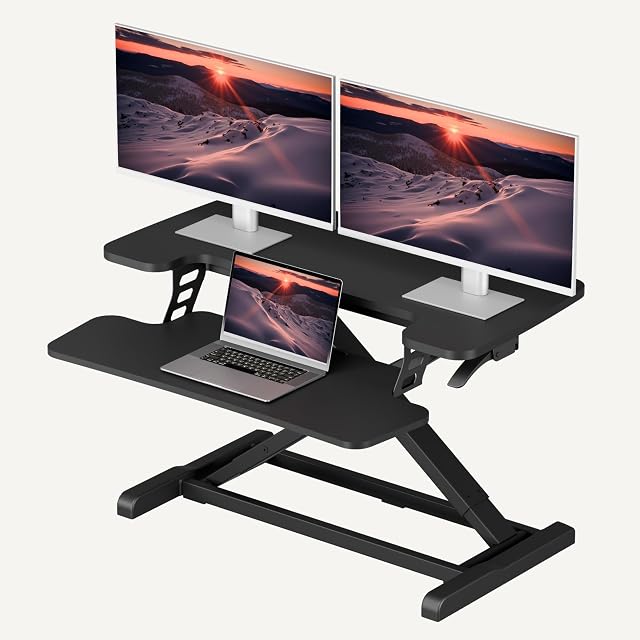
A two-tier converter on a steel-wire mechanical spring rather than a gas cylinder, publishing both surface dimensions and a separate rating for each tier.
Amazon reference
B0H35V1GP6
EAN
0840521567329
Manufacturer reference
1
Top surface
31.5 × 16.3 in (80 × 41 cm)
Keyboard tray
28.3 × 12.2 in (72 × 31 cm)
Height range
4.7–19.6 in (12–50 cm)
Load
33 lb (15 kg) top; 4.4 lb (2 kg) tray
Lift
Mechanical steel-wire spring, patent pending
Assembly
Fit the keyboard tray with the supplied screws; screwdriver not included
Converter weight
Not published
A mechanical steel-wire spring rather than a gas cylinder, so there is no pressure to lose over years
Publishes both surfaces — 31.5 by 16.3 in on top, 28.3 by 12.2 in on the tray
The manufacturer reference on the listing is simply "1"
Best for: A standard desk where the lift mechanism should have nothing in it that can leak.
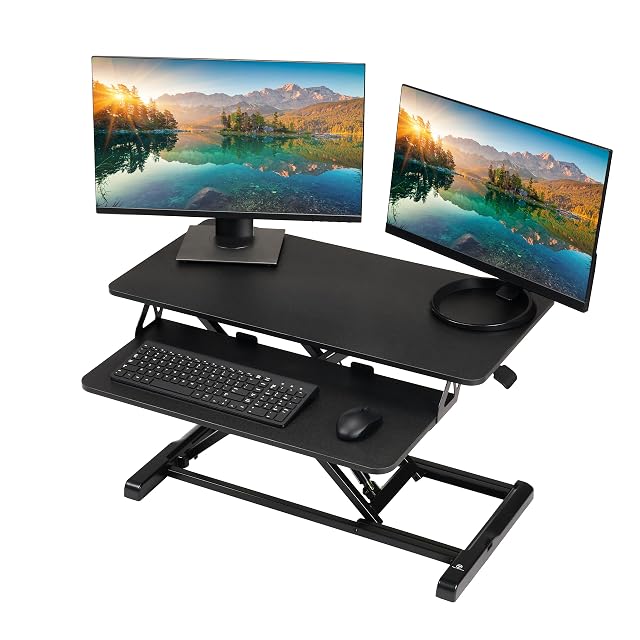
A pneumatic squeeze-handle converter on an aluminum frame, rated to 33 lb — and the only listing on this shelf that names the material of its own work surface.
Amazon reference
B0828B7GNG
EAN
0662578127604
Manufacturer reference
OF-S05-1
Width
32 in (81 cm); depth not published
Height range
4.3–19.7 in (11–50 cm)
Load
33 lb (15 kg); no separate tray rating
Lift
Pneumatic, squeeze handle
Materials
Particle board top, aluminum frame
Assembly
Mostly assembled; keyboard tray fitted with the supplied tools
States the top is particle board on an aluminum frame — the only material statement on this shelf
A pneumatic lift worked by squeezing a handle, rather than by lifting against a spring
Particle board is the cheapest work surface material and the one most easily damaged by moisture
Best for: A converter adjusted several times a day, where a squeeze handle beats a spring you fight.